 Block History
10 facts about Alfred the Great, and how each looks from above
Ten facts about Alfred the Great for kids and teachers, with what each one looks like in our free Edington diorama. We say what is known and what is guesswork.
Alfred the Great was a king of Wessex in the 800s who held off Viking armies, won a battle at Edington in 878, and later became king of the English. Here are ten facts about him. After each one, we say what it looks like in our Edington diorama, where you can see the ground and watch the moments in order.
We mark each fact as known, legend or disputed. Most of what we know about Alfred comes from the Anglo-Saxon Chronicle and from a life of Alfred written by a man called Asser. Both were written by people with a view of their own, so we say so where it matters.
1. He ruled for about 28 years
He was king of the West Saxons from 871 and, from about 886, king of the Anglo-Saxons, until his death in 899. That is known from the sources, though historians argue over exactly when “king of the English” began to fit him.
From above: the scrub bar under the diorama is a good way to feel a long reign. One scene shows only a few days, and a whole life sits around it.
2. Later writers called him “the Great”
The name came long after his death, and he is the only Anglo-Saxon king remembered that way. (Cnut, a Danish king of England, is called “the Great” too.) Nobody can measure greatness, so treat it as a title people gave him later, which tells you how he was remembered.
3. He became king in 871, when Wessex was under attack
Alfred took the throne in 871 after the death of his brother, the king before him. Vikings were already fighting in Wessex. He did not start with a quiet kingdom.
4. A surprise attack drove him into hiding
Early in 878, a Viking army struck at Chippenham, and Alfred went into the marshes of Somerset with a small band. The Chronicle gives the outline. How many people were with him, and how long he stayed hidden, is not something we can state with confidence.
From above: the scene itself is set on the open down at Edington, not in the marshes, but its first moment card tells how Wessex was overrun and Alfred went into hiding at Athelney.
5. The burnt cakes are a legend
You may have heard that Alfred, hiding in a poor home, let the cakes burn. The tale was written down long after his death. It is a good story and may be nothing more.
6. The battle of Edington was in 878
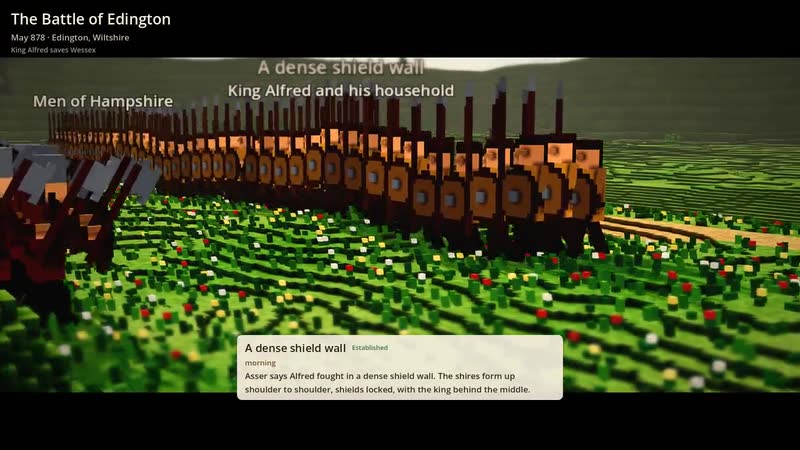
Alfred gathered men and met the Viking army at Edington, in Wiltshire. He won. The date and the result are known. Many of the details, such as where each group stood and how the fighting moved, are reconstructed from short accounts and from the shape of the land.
From above: in our scene, each moment is marked established, likely or reconstructed. Pause on any moment and you can see which kind it is.
7. The Viking leader accepted baptism
After Edington, the Viking leader Guthrum agreed to peace and was baptised, with Alfred standing as his godfather. This comes from the Chronicle and Asser. It was a way to end a war without wiping out the other side.
8. He built fortified towns
Alfred set up fortified towns called burhs, so that people had a safe place to go and soldiers could be called quickly. Historians know about them from a later list called the Burghal Hidage, which names the burhs and how many men each needed to defend it.
From above: the Edington scene has no burh in it, but it shows how much the ground decides. Follow one unit and notice how the open down and the steep scarp decide where it can go.
9. He cared about learning
Alfred wanted books and teaching in English. Teaching sites call this the “Alfredian Renaissance.” Which books he translated himself, and which his helpers did, is argued over, so be careful with “Alfred wrote this.”
10. He died in 899
He died on 26 October 899. His reign and the years of war and building make up the rest of the story.
Using this in class
For a lesson, ask students to find one thing that is known and one that is reconstructed, and to say how they can tell. Our page for teachers and homeschoolers explains how the scenes work in a lesson. How it works shows how each scene is built from the sources. The scenes are free, with no accounts, no sign-ups and no ads.
Alfred at Edington was one of the first three scenes, along with Lexington and Concord (1775) and the Mary Rose (1545).
Play this scene in your browser, or download it for Mac or Windows. Teachers: put it on the projector and pause on any moment.