 Block History
Alfred the Great and the battle of Edington, 878
Alfred the Great fought the battle of Edington in 878. Here is what the sources record, what is reconstructed, and how to see the battle from above.
Alfred the Great was a king of Wessex. In 878 he fought a battle at Edington after being pushed back and gathering his people. That is the short answer. The rest of this page covers how we know it, what is still uncertain, and how you can watch the fight yourself.
Who was Alfred?
Alfred was born in 849 at Wantage, in what is now Oxfordshire. He became king of the West Saxons, the people of Wessex in the south of England. Later writers gave him the name “the Great”, and he is the only Anglo-Saxon king remembered that way.
Most of what we know about him comes from a few old written sources, and some of those were written by people who admired him. When a story about Alfred is told, it helps to ask who wrote it down, and when.
A king pushed back
In January 878, just after Twelfth Night, a Danish army led by Guthrum made a surprise attack on Chippenham, where Alfred was staying for the winter. Much of Wessex gave in. Alfred escaped with a small band into the marshes of Somerset and built a fort at Athelney. The Anglo-Saxon Chronicle says that in the seventh week after Easter he rode to Egbert’s Stone, and the men of Somerset, Wiltshire and the part of Hampshire this side of the sea came to meet him there.
The sources are thin on the details of that gathering. We will not pretend to know who stood next to whom on the road to Edington. Where the record goes quiet, we say so.
The fight at Edington
From Egbert’s Stone, Alfred’s army camped a night at Iley, then marched to Ethandun, usually read as Edington in Wiltshire. Asser says they fought in a dense shield wall, long and hard, and the Chronicle says Alfred put the whole Danish army to flight. He followed them to their stronghold and besieged it for fourteen days, until they gave hostages and swore oaths to leave. Three weeks later Guthrum was baptised at Aller, with Alfred as his godfather, and took the name Æthelstan. The Danes left Wessex, and by 880 they had settled in East Anglia.
What is harder to know is the ground itself and where each group of people stood. Those parts are reconstructed from the sources and from what we can learn about the land. Historians do not all agree on every point. In our scene, each moment is marked known or reconstructed, so you can see which is which.
What about the cakes?
You may have heard that Alfred once burned some cakes. That is one of the legends told about him, and heritage organisations such as the South West Heritage Trust list it with other Alfred legends. It is a good story. It is a legend, though, and not something we show as known fact.
See Alfred at Edington from above
Our Alfred at Edington scene is one of the first three in Block History. It rebuilds the battle as a block diorama: the ground, the people, where they stood and how it moved. You can look down on the whole thing, or move in close.
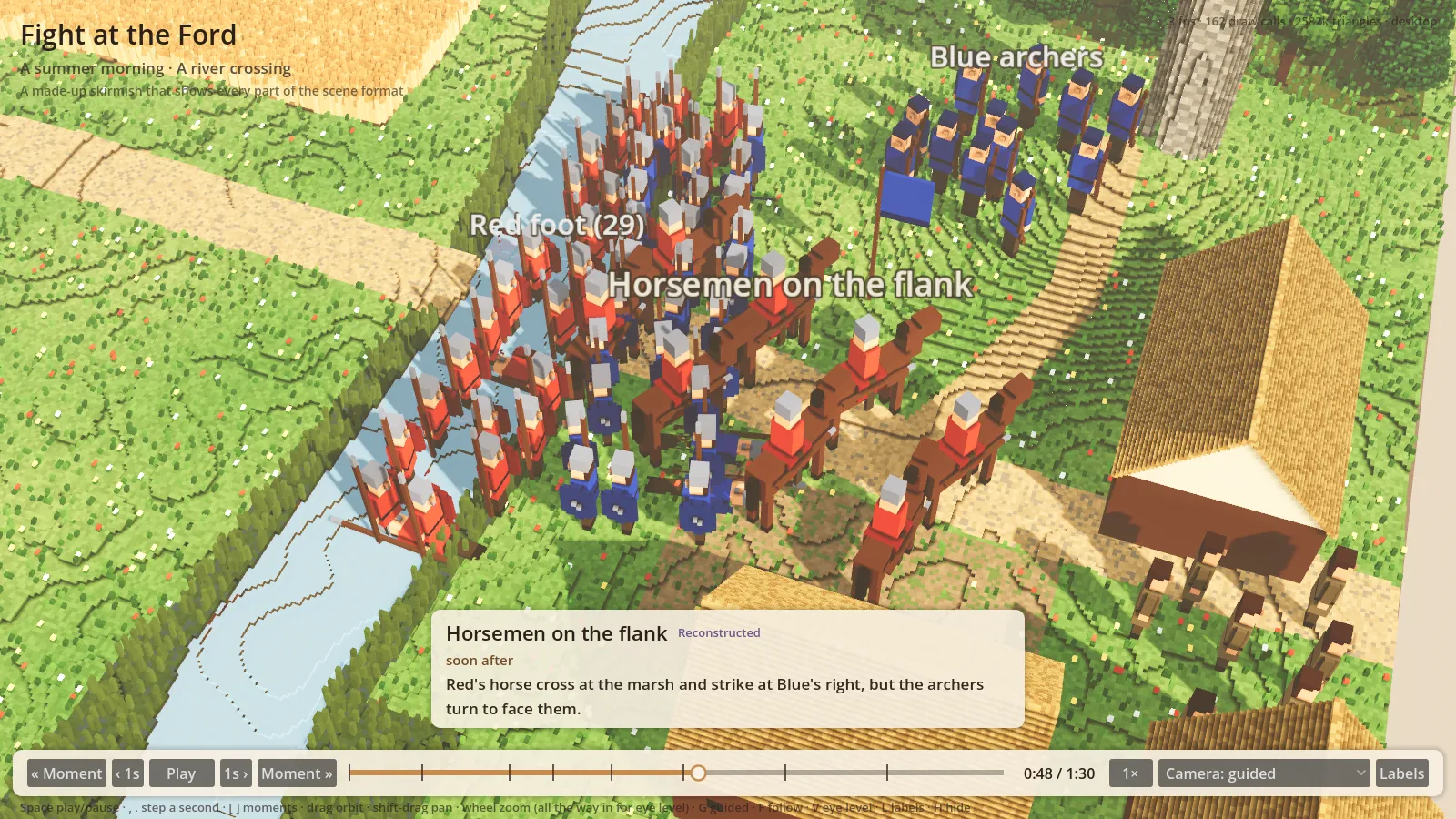
Here is what you can do in the scene:
- Play it, pause it, or scrub back and forth along the timeline.
- Step one moment at a time.
- Follow a single unit and see the fight from its side.
- Stand at eye level and look across the ground.
Every scene starts from the sources: the ground, the people, and the moments in order. Each moment is marked known or reconstructed. You can read more on how it works, or see all of the scenes.
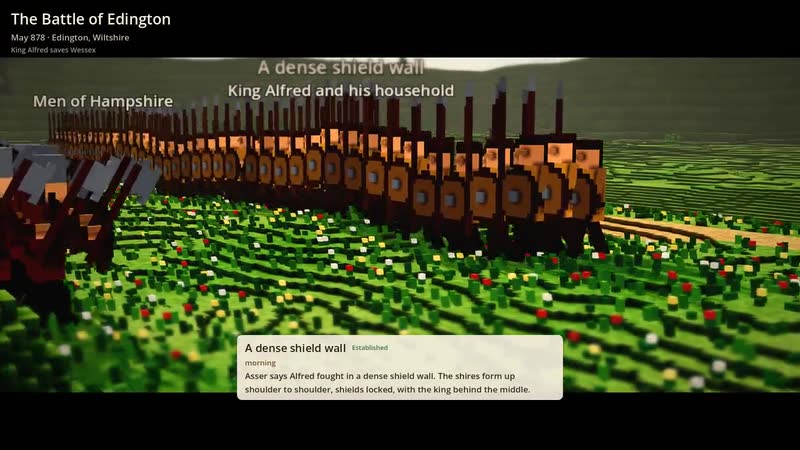
The labels in the player show who each group is, so you can pick one out and watch where it goes.
For teachers and homeschoolers
A battle is hard to explain with words alone. Pause the scene on one moment and ask a class where they think each group will go next. Then press play and find out. There are no accounts, no sign-ups and no ads, so it works on a projector without any setup. More ideas are on the page for teachers and homeschoolers.
Put it on the projector and pause on any moment. Play this scene in your browser, or download it for Mac or Windows. Block History is free.